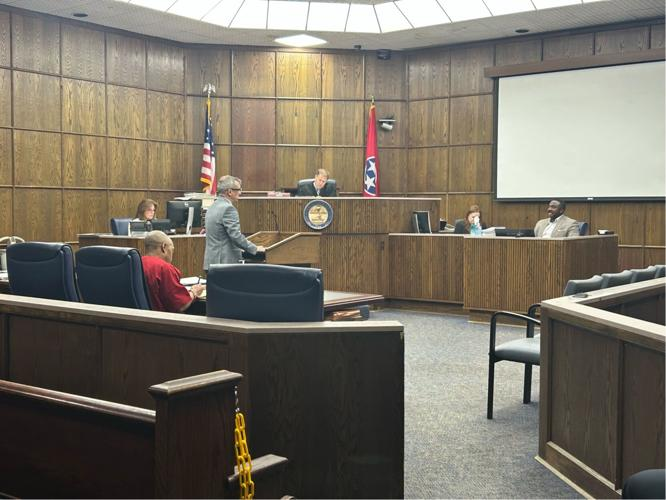
Former Louisville officer Nathan Stotts pleaded not guilty to second-degree manslaughter and reckless homicide in Martin Nitzken Jr.’s death and posted bond after arraignment.

The Crime
The primary submitted source is wdrb.com. Facts not reliably supported by the current source set are left unresolved rather than inferred.
| Crime Location | Location identified in the cited case-specific reports. |
|---|---|
| Date and Time | 2026-06-22 |
| Investigating Agency | Investigating police, prosecutor, court, corrections, or government authority identified in the cited case-specific reports. |
| Suspect or Defendant | The person or persons identified in the cited case-specific reports |
| Age | Not reliably reported in the available source set. |
| Charges / Legal Posture | Charges or investigative status identified in the cited case-specific reports |
| Bond or Custody | A verified current bond amount was not available in the available source set. |
| Conviction | No conviction reported in the available source set. |
| Sentence | No sentence reported in the available source set. |
| Current Outcome | Former Louisville officer Nathan Stotts pleaded not guilty to second-degree manslaughter and reckless homicide in Martin Nitzken Jr.’s death and posted bond after arraignment. |
| Victim | Victim information is limited to what is publicly identified in the cited case-specific reports. |
Crime Location
Date and Time
The relevant submitted report date is 2026-06-22. Incident dates and procedural dates are different. An arrest can occur months or years after the underlying event, and a plea, verdict, sentence, appeal, parole ruling, dismissal, or retrial decision may come later still. This record keeps the submitted report date visible while leaving room for later verified developments. When an exact time is not reliably available from the current source set, no time is invented.
Investigating Agency
The principal authority description for this record is Investigating police, prosecutor, court, corrections, or government authority identified in the cited case-specific reports.. Police, prosecutors, courts, medical examiners, corrections agencies, and appellate courts perform different functions. A police allegation is not a charging decision, and a charging decision is not a finding of guilt. The article therefore attributes procedural facts to the kind of authority that actually made the decision. Multi-agency cases can involve separate evidence systems and timelines, so future updates should identify which institution supplied the new information.
Charges and Legal Posture
Bond and Custody
A verified current bond amount was not available in the available source set. Bond and pretrial detention address release before final judgment and should not be confused with punishment. Courts may consider statutory rules, the seriousness of the allegations, public-safety arguments, prior compliance, and flight risk. In a post-conviction matter, custody may instead flow from a sentence, parole decision, or corrections action. When the source set does not reliably state an exact monetary amount, the article says so rather than estimating one.
Evidence and Allegations
<p>The investigation or prosecution may rely on the evidence specifically described in the cited case-specific reports.</p><p>Any later court filing, plea, verdict, sentence, dismissal, appellate ruling, corrected agency release, or verified custody change should supersede an older procedural description when appropriate.</p>Evidence is not self-interpreting. Investigators and prosecutors must establish what an item is, where it came from, who collected it, whether the chain of custody is reliable, and what inference it reasonably supports. Defense counsel may challenge identification, intent, causation, searches, statements, forensic methods, digital attribution, or witness credibility. A dramatic allegation can explain why a case received attention without becoming proof by repetition.
Digital and Forensic Evidence
Phone records, messages, social-media entries, surveillance footage, license-plate data, vehicle records, DNA, ballistics, medical findings, and location information can help build a chronology. Each still requires authentication and context. A phone near a location is not automatically proof of who possessed it, a message needs attribution, and a forensic association has to be interpreted within the limits of the method. The court determines admissibility and the factfinder determines weight.
Court Status
Victim Information
The victim field for this record is: Victim information is limited to what is publicly identified in the cited case-specific reports.. Victim information is limited to what is necessary to understand the public case. Private addresses, unnecessary medical details, and protected juvenile identities are omitted. Reporting can acknowledge the harm described by authorities and families while still preserving due process. Those ideas are not in conflict: the consequences of an event can be serious even when a defendant remains legally presumed innocent.
Source Reconciliation
The source list is intended to be case-specific. Official police, prosecutor, court, corrections, and government records are preferred when available, followed by reliable local, regional, or national reporting that adds independent facts. Generic statutes, agency homepages, search pages, unrelated background, and duplicate syndications are not added merely to inflate a source count. If only one credible case-specific source is available, that limitation is preserved transparently.
What Happens Next
How to Read This Case Record
A crime headline is a snapshot while a criminal case is a moving sequence of events. The useful order is incident, investigation, charge, custody, evidence, plea or trial, judgment, sentence, and appeal. Keeping those stages separate reduces two common errors: treating an arrest as proof and leaving an old procedural headline online after the legal posture has materially changed. This article is written as a living case record so later verified developments can replace obsolete ones without producing duplicate posts.
Chronology
- 2026-06-22: the submitted report described the case development summarized here.
- Later case events should be added only when supported by a case-specific source.
Conviction
No conviction reported in the available source set.
Sentence
No sentence reported in the available source set.
Reporting Standards for Later Updates
Later coverage should be checked against the same case identifiers before a new post is created. Names can be spelled differently, defendants can be added, and headlines can shift from an incident description to a person-centered court update. Matching the location, victim, incident date, charge pattern, source URLs, and distinctive facts helps determine whether the new material belongs in this article. When there is one clear canonical match, updating it keeps the site coherent. When multiple live posts could plausibly match, the publisher should stop rather than guess which record to overwrite.
Procedural language should also advance with the case. Someone described as wanted should not remain wanted after a verified arrest. A defendant who has pleaded guilty should no longer be described only as accused on that adjudicated count. A conviction reversed on appeal should not remain presented as final, and a dismissed charge should not be left in a headline as though it is still pending. The purpose of a living case record is to make the current legal status easier to understand, not to preserve every obsolete headline forever.
Reporting Standards for Later Updates
Reporting Standards for Later Updates
Reporting Standards for Later Updates
Sources
Disclaimer: This article summarizes case-specific public reporting reviewed through August 7, 2026. Charges remain allegations unless a valid plea or court judgment establishes guilt. Later court records or agency releases may correct or expand the information reported here.